Separate addresses, right-to-left layout, fonts and dates. What we learned when we added Persian to an English website.
Adding a language sounds like translating strings. When we added Persian to this website, the strings were the easy part. These are the decisions that mattered.
Give each language an address
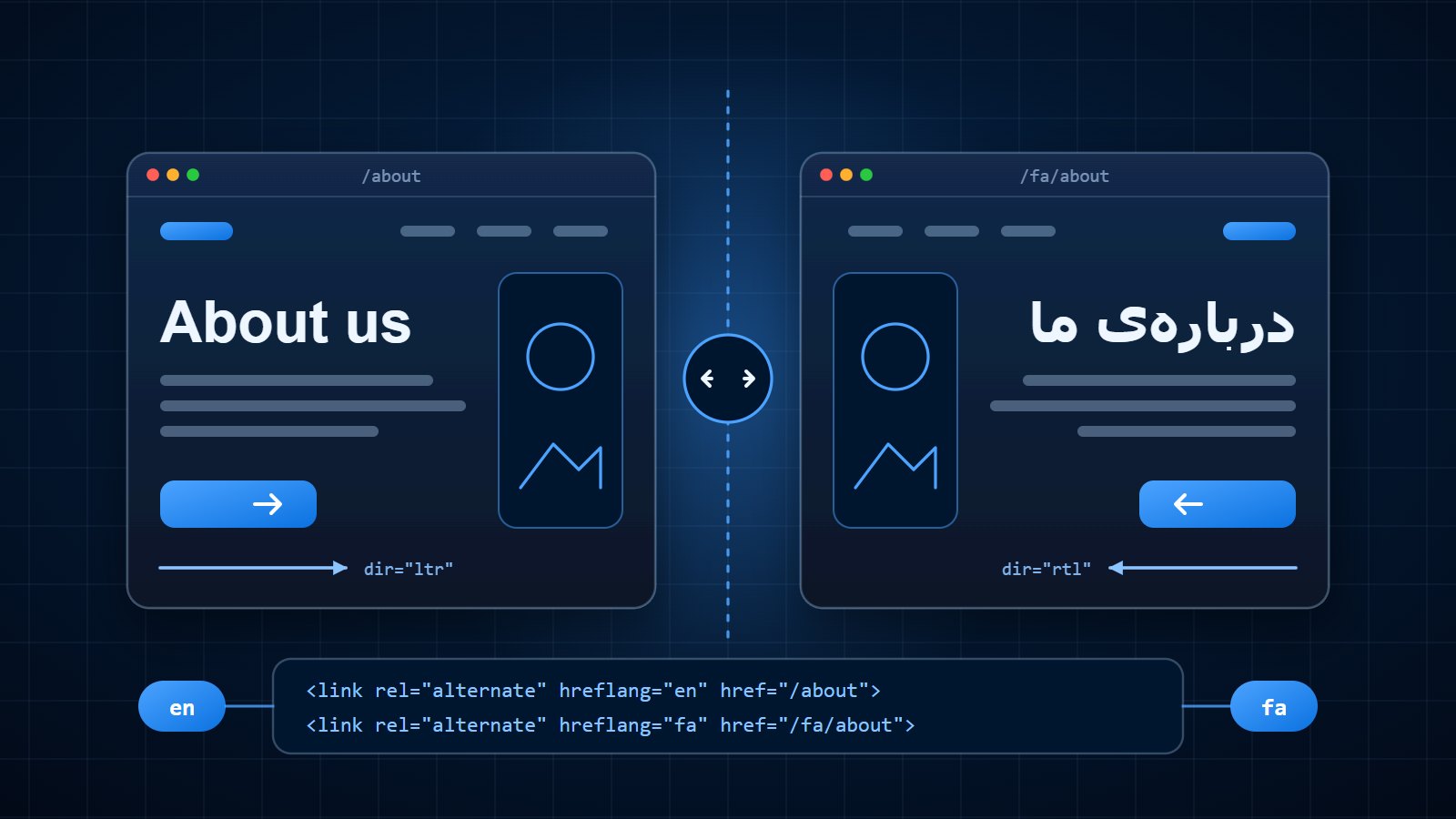
English pages are at /about and Persian pages at /fa/about. A button that only switches the text in the browser gives search engines one page and gives people a link that opens in the wrong language. With separate addresses you can also tell search engines about the pair:
html<link rel="alternate" hreflang="en" href="https://example.com/about">
<link rel="alternate" hreflang="fa" href="https://example.com/fa/about">
Only offer a page in a language when it is really translated. Our articles began in English only, so we did not announce a Persian version of them.
Set the direction on the page
<html lang="fa" dir="rtl"> does most of the work, if the styles allow it. Write styles with logical sides:
margin-inline-startinstead ofmargin-left,text-align: startinstead ofleft,padding-inline-endinstead ofpadding-right.
Know what should not flip
Arrows that mean "next" and "back" turn around. Logos, code, phone numbers, email addresses and videos do not. A code block inside a Persian page needs its own dir="ltr".
Choose a font for both alphabets
We use one font for Latin letters and Vazirmatn for Persian. The unicode-range rule lets the browser download only what the page uses, so English visitors do not pay for Persian letters.
Persian letters connect to each other. Effects that split a heading into single letters break the word. Split by word instead.
Use the platform for dates and numbers
The browser already knows the Persian calendar:
jsnew Date().toLocaleDateString("fa-IR", { dateStyle: "long" });Keep one time zone for dates that are rendered on the server and again in the browser, or the two may disagree near midnight.
Mind the small words
- Keep the half-space inside Persian words that need it.
- Use Persian quotation marks and the Persian question mark.
- Let a native speaker read it in the interface, not in a table. A correct word can still be too long for its button.
Test it like a feature
Open every page in both directions, on a phone and on a wide screen. Look for horizontal scrolling, cut words and icons that point the wrong way. Check that moving between pages keeps the language.